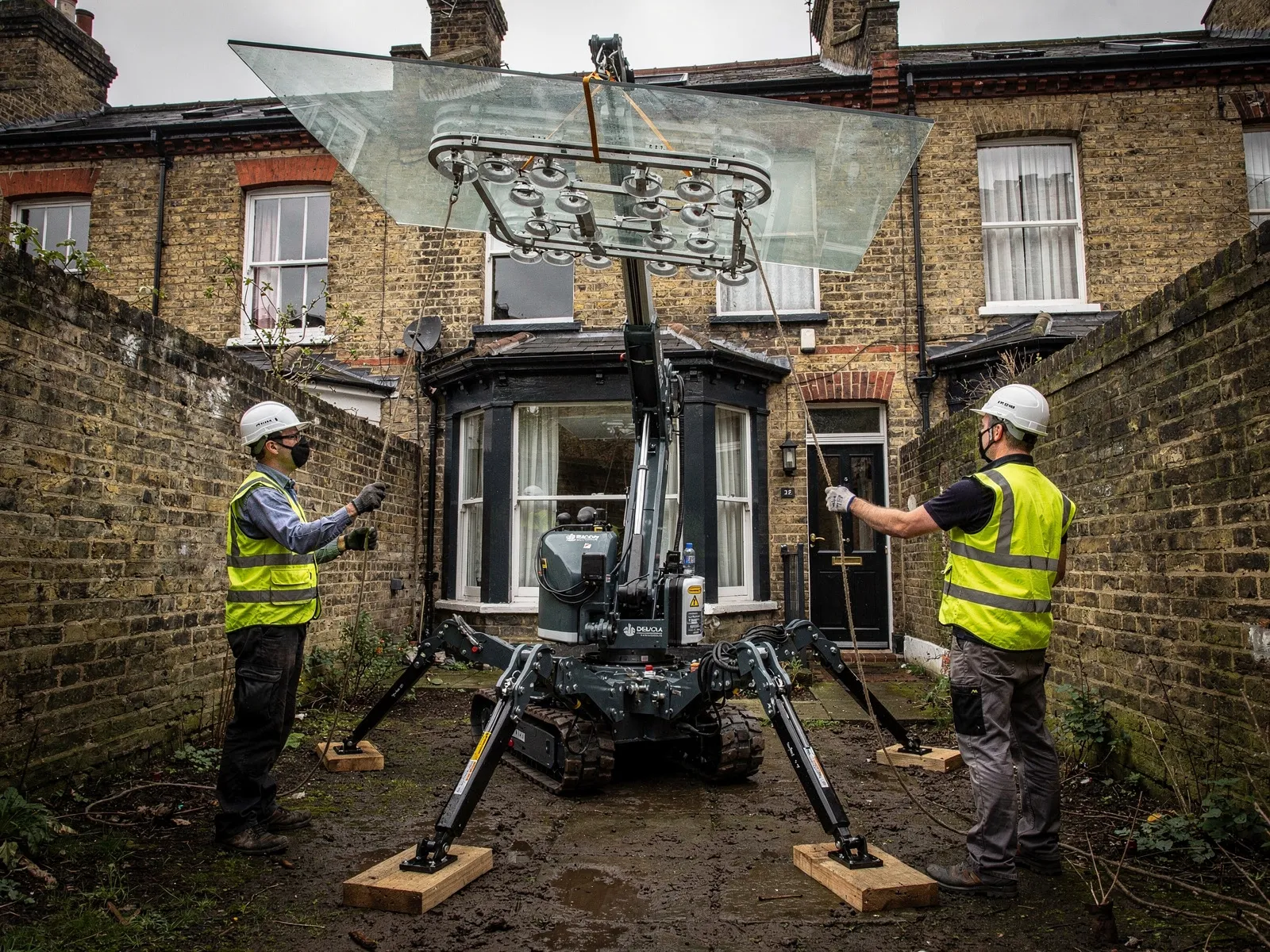
A spider crane is a small crawler crane on rubber tracks, with four outrigger legs that fold out like a spider's to keep it stable. It can travel through a house, along a side passage or into a goods lift, then lift loads that would otherwise need a much bigger crane parked on the road.
Typical jobs
Glazing and rooflights
Fitted with a vacuum lifter, a spider crane places large glass panels precisely, without a scaffold hoist.
Steel beams
Lift RSJs and steel frames into rear extensions and loft conversions where a mobile crane cannot reach.
Inside buildings
Electric models with non-marking tracks work indoors: shopping centres, atriums, factories and plant rooms.
Restricted sites
Back gardens, courtyards and basements with access through a gate, a passage or a standard door.
When a spider crane is the right choice
Choose a spider crane when access is the problem, not weight. If a mobile crane cannot get close enough, or its outriggers would block the road, a spider crane set up beside the work is often cheaper and quicker. For heavier loads where the crane can park next to the site, a mobile crane or a HIAB lorry crane is usually better value.
Spider cranes also suit jobs where a bigger crane would need a road closure. Because the crane works from inside the site, you often avoid a highway permit altogether.
How a spider crane job runs
- Delivery. The crane arrives on a beavertail lorry and tracks off under its own power.
- Tracking in. The operator walks it to the lift position by remote control, through the gate, passage or doorway.
- Set-up. The four outriggers fold out onto spreader mats and the crane levels itself. This takes 15 to 30 minutes.
- Lifting. The operator works the crane by radio remote, so they can stand where they see the load best.
- Pack-down. The legs fold in and the crane tracks back out. A typical domestic job takes half a day to a day.
What is included
- A spider crane sized for your load, delivered and collected
- An operator with a CPCS or NPORS card for the crane
- Spreader mats for the outriggers and standard lifting accessories
- Optional vacuum lifter, glass manipulator or fly jib for extra reach
- Optional contract lift: site survey, lift plan and Appointed Person
Spider crane or mini crane?
A spider crane is one type of mini crane. If your lift needs a crane that can carry the load across the site rather than lift from a fixed position, or a crane that works in very low headroom, see mini crane hire for pick-and-carry and mini crawler cranes.
Spider crane sizes
Typical figures for each class. Exact capacity depends on the model and the radius of the lift, so we size every crane from your load and the reach needed.
| Class | Max capacity | Width | Hook height | Typical jobs |
|---|---|---|---|---|
| Compact | Up to 1 t | 600 – 750 mm | 8 – 9 m | Through a doorway: interiors, atriums, rooftop plant |
| Mid-size | 2.5 – 4 t | 750 – 1,300 mm | 13 – 17 m | Glazing, steel for extensions, garden lifts |
| Large | 5 – 10 t | 1.3 – 2 m | 20 – 30 m | Curtain walling, precast, plant rooms, heavier steel |