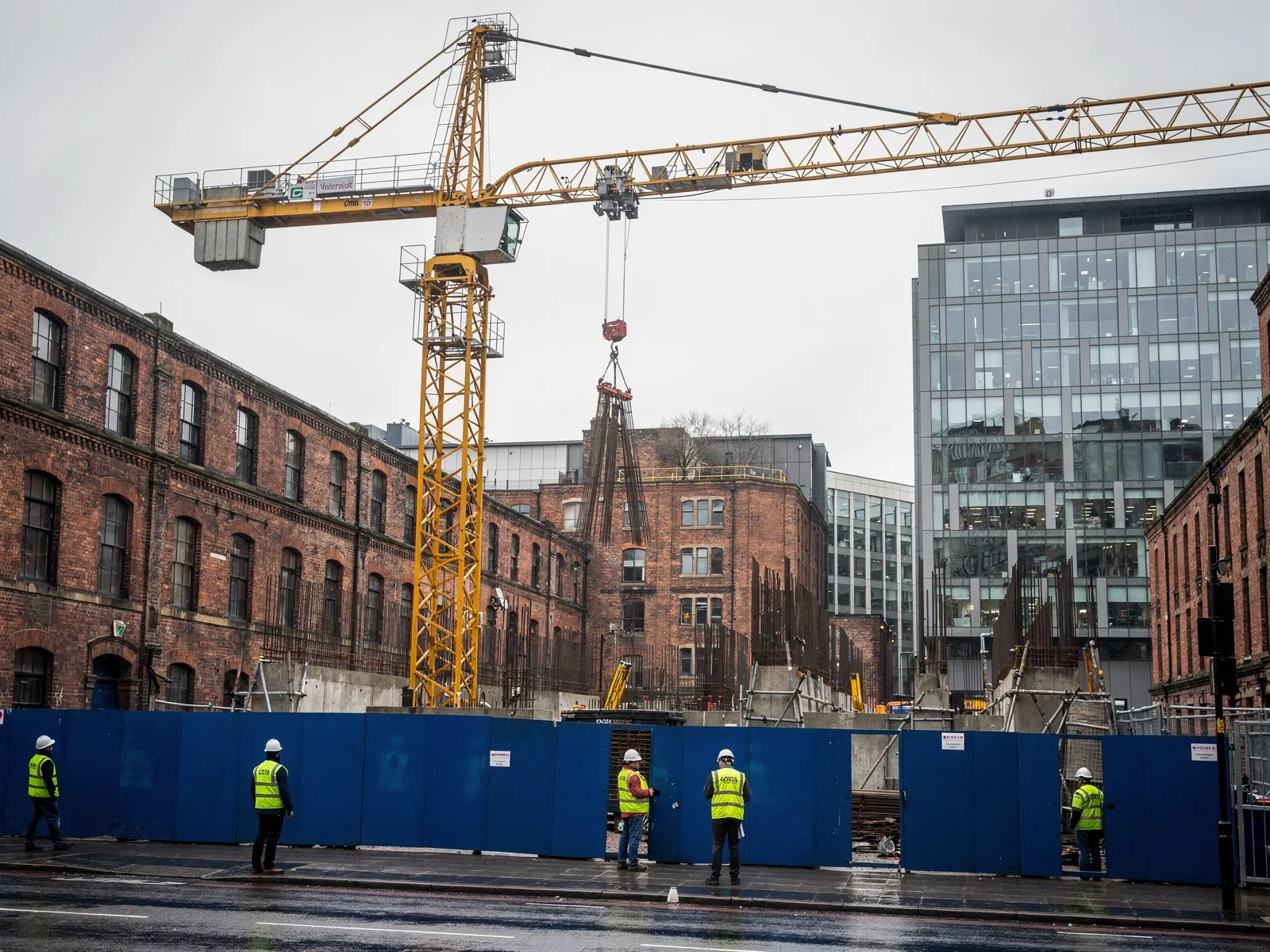
A tower crane is the right choice when a project needs lifting every day for weeks or months. It stands on a fixed base, reaches across the whole site and keeps working at height without taking up road space. Hiring one is a project in itself: foundations, erection, operators, oversail rights and regular inspections all need planning.
Typical jobs
Residential blocks
Flats and student accommodation, where the crane serves every floor from day one to topping out.
Commercial buildings
Offices and mixed-use schemes, often with luffing jibs to stay within the site boundary.
Housing sites
Self-erecting tower cranes moving materials across plots on house-building sites.
Infrastructure
Bridges, rail and water projects where heavy, repeated lifts continue for months.
Is a tower crane right for your project?
A tower crane makes sense when lifting is continuous. If you need a crane for a few days, a mobile crane is almost always cheaper. If lifts will happen most days for six weeks or more, the economics usually swing towards a tower crane.
For smaller projects, such as a terrace of houses or a low-rise block, a self-erecting tower crane offers the best of both: it arrives on one lorry, puts itself up in a day and needs only a simple ballast base.
What a tower crane hire includes
- Crane selection and design: choosing the type, jib length and position to cover the whole site
- Foundation design: a cast base, piled base or ballasted cross-frame, designed by a temporary works engineer
- Delivery and erection: with a mobile crane to assemble the tower and jib
- Operators: CPCS-carded tower crane operators for the length of the hire
- Examinations: thorough examination after erection and at regular intervals under LOLER
- Dismantling and removal at the end of the project
Planning timeline
| Stage | Typical lead time |
|---|---|
| Crane selection and quotation | 1 – 2 weeks |
| Foundation design and approval | 2 – 4 weeks |
| Oversail agreements and aerodrome notification | 2 – 8 weeks |
| Casting and curing the base | 2 – 4 weeks |
| Erection and commissioning | 1 – 5 days |
Start the conversation as early as you can. Tell us the site, the heaviest lift and the programme, and we will put together a tower crane proposal.
Types of tower crane
Typical figures for each class. Exact capacity depends on the model and the radius of the lift, so we size every crane from your load and the reach needed.
| Type | Typical capacity | Jib | Best for |
|---|---|---|---|
| Self-erecting | 1 – 8 t | 20 – 50 m | Housing, small sites; erects itself in a day |
| Flat-top (topless) | 4 – 25 t | 30 – 80 m | Sites with several cranes working close together |
| Hammerhead | 4 – 20 t | 40 – 80 m | Open sites with no oversail constraints |
| Luffing jib | 6 – 25 t | 30 – 65 m | Tight city sites; jib raises to avoid oversailing |