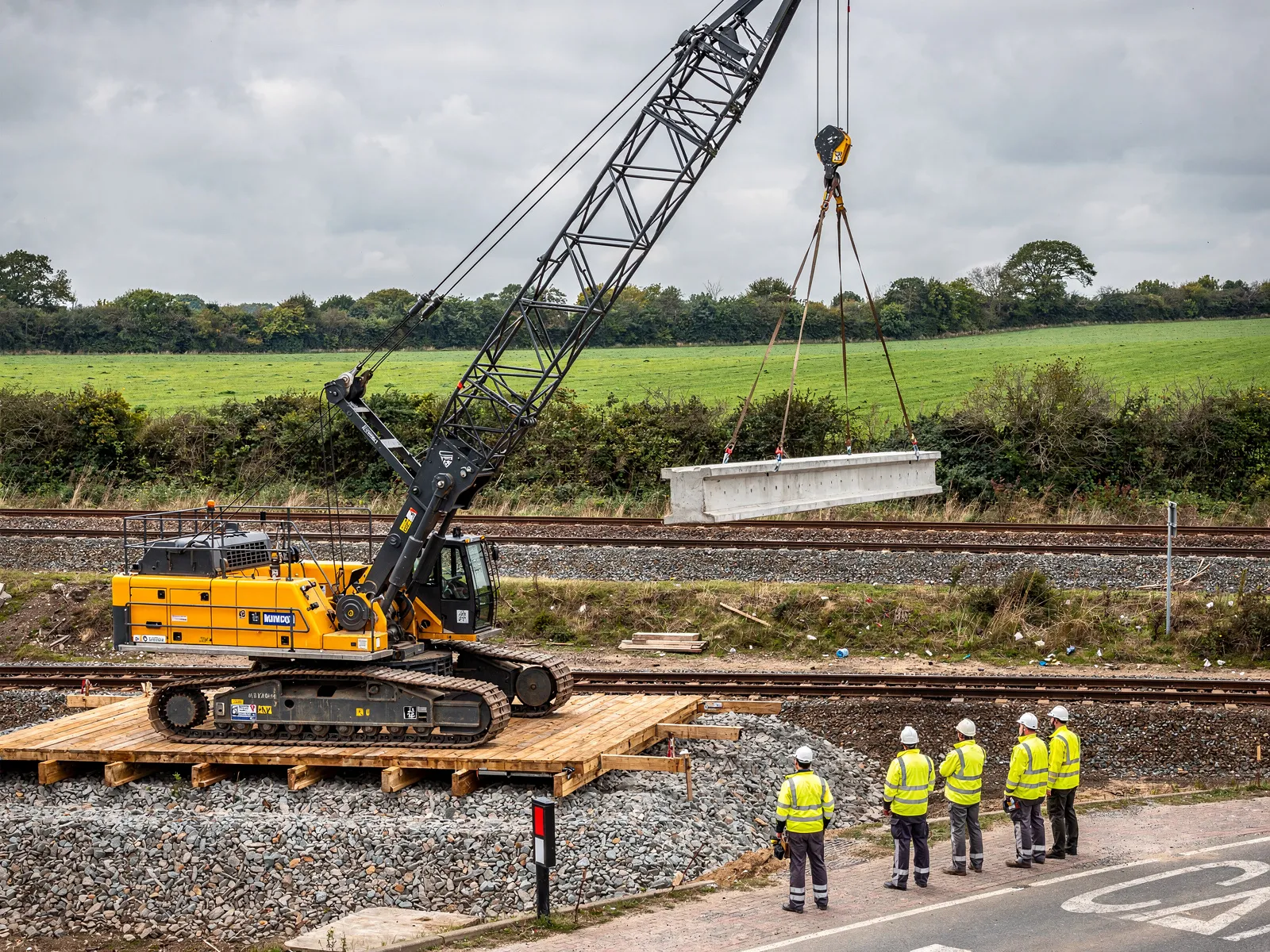
A crawler crane sits on steel tracks instead of wheels. The wide tracks spread its weight, so it can work on ground where a wheeled crane's outriggers would sink, and it can travel around a site carrying the load. Crawler cranes range from small telescopic machines to the largest cranes in the UK.
Typical jobs
Piling and foundations
Handling piling rigs, rebar cages and casings on soft ground.
Bridges and rail
Placing bridge beams and rail structures, often over weekend possessions.
Energy
Wind turbines, substations and power plant components.
Long projects
Steel and precast erection where the crane moves along the building as work progresses.
Telescopic or lattice boom?
Telescopic crawler cranes have a boom that extends hydraulically, like a mobile crane. They arrive almost ready to work, set up in hours and are ideal for jobs where the crane needs to move frequently.
Lattice boom crawler cranes have a boom built from steel sections pinned together. They take longer to assemble but lift far more for their weight, and they reach greater heights. For heavy or long-term projects they are usually the most efficient choice.
What goes into a crawler crane hire
- Lift study: crane selection, load charts and ground bearing pressure calculations
- Working platform design where the ground needs improving
- Transport and assembly, including the assist crane for lattice machines
- Operators and crew: a crawler crane operator, slinger-signallers and an Appointed Person on contract lifts
- Thorough examinations under LOLER for the length of the hire
Because crawler crane jobs are bigger and longer, most are carried out as a contract lift, with the crane company planning and supervising the work.
Read more in our guides to crawler cranes in industrial construction and reading a crane load chart.
Types of crawler crane
Typical figures for each class. Exact capacity depends on the model and the radius of the lift, so we size every crane from your load and the reach needed.
| Type | Capacity | Transport | Best for |
|---|---|---|---|
| Telescopic crawler | 30 – 150 t | 1 – 3 lorries | Quick set-up, moving round site, rough ground |
| Small lattice crawler | 50 – 150 t | 3 – 8 lorries | Piling support, steel, long-duration lifting |
| Large lattice crawler | 250 – 1,000+ t | 15 – 60+ lorries | Bridges, energy, major infrastructure |