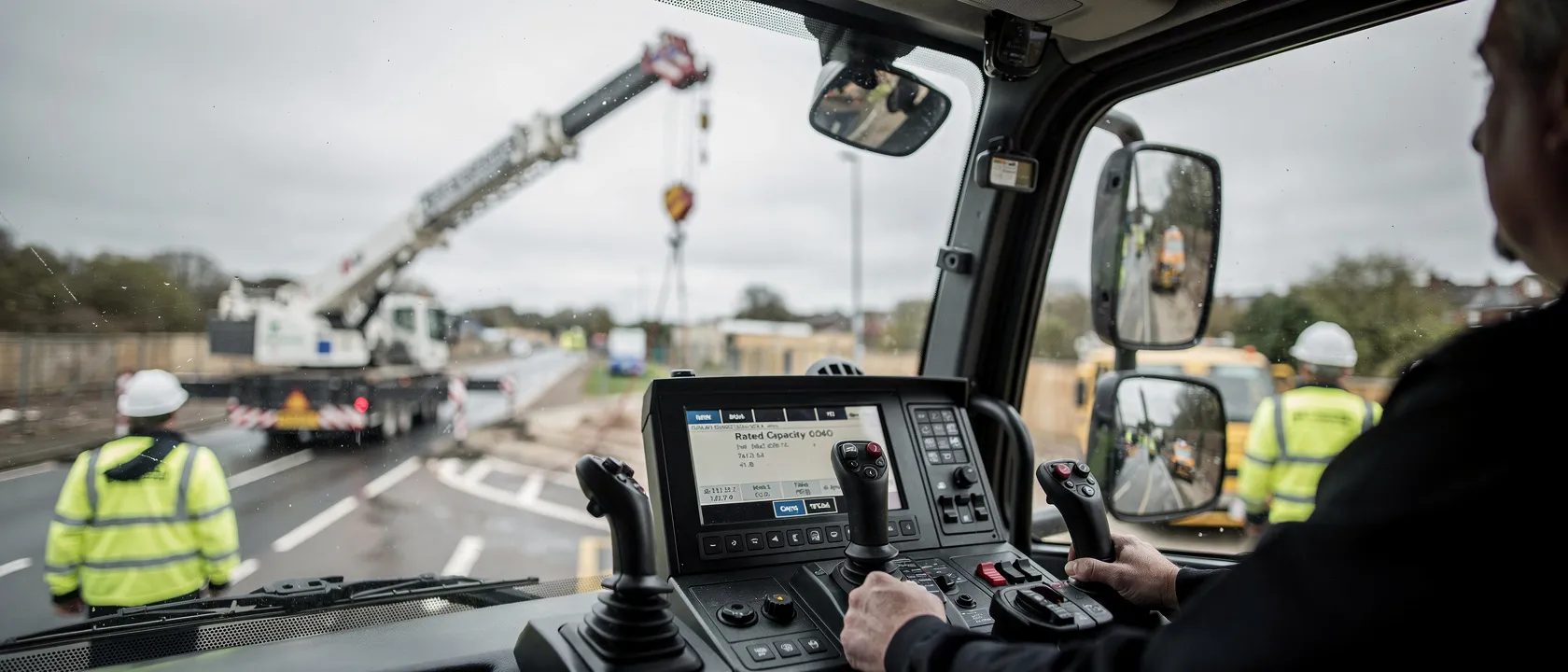
A crane’s headline tonnage tells you very little about what it can lift for you. The load chart does. Learning to read one helps you understand why a “60-tonne crane” may be needed to lift a 2-tonne load.
Load charts are specific to each crane model and configuration. This guide explains the principles. Every real lift must be planned by a competent Appointed Person using the manufacturer’s chart for the actual crane.
What a load chart shows
A load chart is a table, usually one for each crane configuration, that gives the rated capacity (the maximum the crane can lift) for each combination of:
- Radius: the horizontal distance from the centre of rotation to the centre of the hook
- Boom length: how far the telescopic boom is extended
- Configuration: counterweight fitted, outrigger spread and working area (360° or over the rear only)
Read across to your boom length and down to your radius: where they meet is the rated capacity.
Why capacity falls with radius
A crane resists tipping using its counterweight and outrigger footprint. The tipping force is the load multiplied by the radius, called the load moment. Double the radius and you double the load moment, so the crane can lift roughly half as much. In practice capacity falls even faster at long radius because the boom’s own weight counts too.
Deductions: what counts as “the load”
The chart capacity covers everything hanging from the boom tip, not just your load. You must deduct:
- the hook block (often 0.3–1 tonne on a mid-size crane)
- slings, shackles and spreader beams
- attachments such as vacuum lifters
- any jib that is stowed on the boom or rigged but not used, if the chart says so
A worked example
You need to lift a 2,000 kg air handling unit onto a roof. The crane can set up 18 m from the set-down point (measured to the crane’s centre of rotation), and the boom needs to be about 30 m long to clear the roof edge.
| Item | Weight |
|---|---|
| Air handling unit | 2,000 kg |
| Spreader beam and slings | 250 kg |
| Hook block | 400 kg |
| Total load on the hook | 2,650 kg |
On a typical 60-tonne all-terrain crane with full counterweight and outriggers, the chart might show about 4,800 kg at 18 m with a 30 m boom. The lift is around 55% of capacity, which is comfortable. A 40-tonne crane might show only 2,900 kg in the same position: technically enough, but with little margin for wind or a heavier-than-expected unit. Most planners would choose the 60-tonne crane.
Other things that reduce capacity
- Wind: the chart assumes calm or limited wind; large, light loads such as panels catch wind and may need lower limits
- Side loading: cranes are designed for vertical loads, so dragging or swinging loads sideways is not allowed
- Ground: the chart assumes the crane is level and the ground can take the outrigger loads
- Partial outriggers: a reduced outrigger spread uses a different, lower chart
- Over-front lifting: some cranes have reduced capacity over the front of the carrier
The rated capacity indicator
Modern cranes have a rated capacity indicator or limiter that calculates the load as a percentage of capacity in real time and stops the crane approaching overload. It is a safeguard, not a planning tool.
Let a professional check it
On a contract lift, the Appointed Person does this calculation as part of the lift plan. If you are planning your own CPA hire, send us your weights and radii and we will check the crane is right. See also determining a safe lifting load.