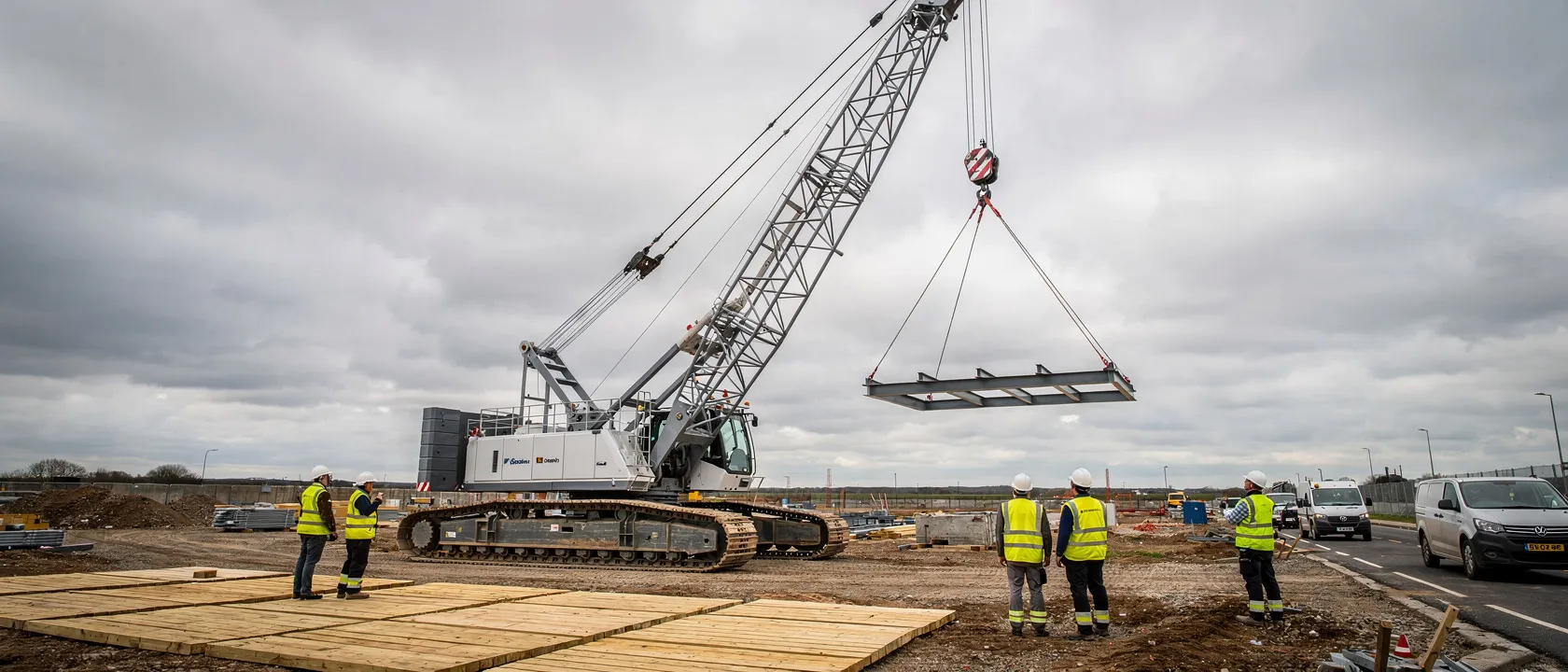
When a lift is too heavy, too long-running or on ground too soft for a wheeled crane, the answer is usually a crawler crane. This guide explains how they work, the main types, and what to expect when you hire one.
What is a crawler crane?
A crawler crane is a crane mounted on steel tracks instead of wheels. The tracks do two jobs: they spread the crane’s weight over a large area, so it can work on softer ground; and they let the crane move around site while carrying a load, something a mobile crane on outriggers cannot do.
Crawler cranes range from mini crawlers of a tonne or two to some of the largest land cranes in the world, rated at several thousand tonnes.
Types of crawler crane
Telescopic crawler cranes
These have a hydraulic telescopic boom like a mobile crane’s. They arrive on one or two lorries, are working within hours, and can move around site easily. Typical capacities are 30 to 150 tonnes. They are popular for piling support, bridge work and general lifting on rough ground.
Lattice boom crawler cranes
These have a boom built from steel lattice sections pinned together on site. Lattice booms weigh less than telescopic booms for the same length, so the crane lifts more and reaches higher. Assembly takes longer and needs space and an assist crane, but for big or long projects they are the most efficient choice.
Mini and compact crawlers
Small tracked cranes, including spider cranes, for restricted sites and indoor work.
Where crawler cranes are used
- Piling and foundations: handling rigs, casings and rebar cages
- Bridges and rail: placing beams, often during short weekend possessions
- Energy: wind turbines, power stations, substations and transformers
- Industrial plant: refineries, chemical works and process equipment
- Large buildings: steel and precast erection where the crane moves along the structure
Advantages and trade-offs
| Advantages | Trade-offs |
|---|---|
| Works on softer ground with lower bearing pressure | Cannot drive on the road; needs transport |
| Can travel with the load (pick and carry) | Lattice cranes take time and space to assemble |
| Very high capacities and heights | Mobilisation costs are high for short jobs |
| Stable for long, repetitive lifting | Ground still needs assessing and often a working platform |
Ground and working platforms
Crawler cranes still need firm, level ground. Most sites need a designed working platform, usually compacted stone with crane mats on top, sized for the crane’s track pressures. A temporary works engineer designs this, often following BRE 470 guidance.
Safety
Crawler crane lifts follow the same rules as any crane lift: LOLER, BS 7121 and a lift plan from an Appointed Person. Travelling with a suspended load adds extra risk, so the route, ground and load restraint must all be planned.
Hiring a crawler crane
Crawler cranes are usually hired by the week or month, with transport, assembly and an operator, and most jobs are done as contract lifts. See crawler crane hire for typical sizes and prices.