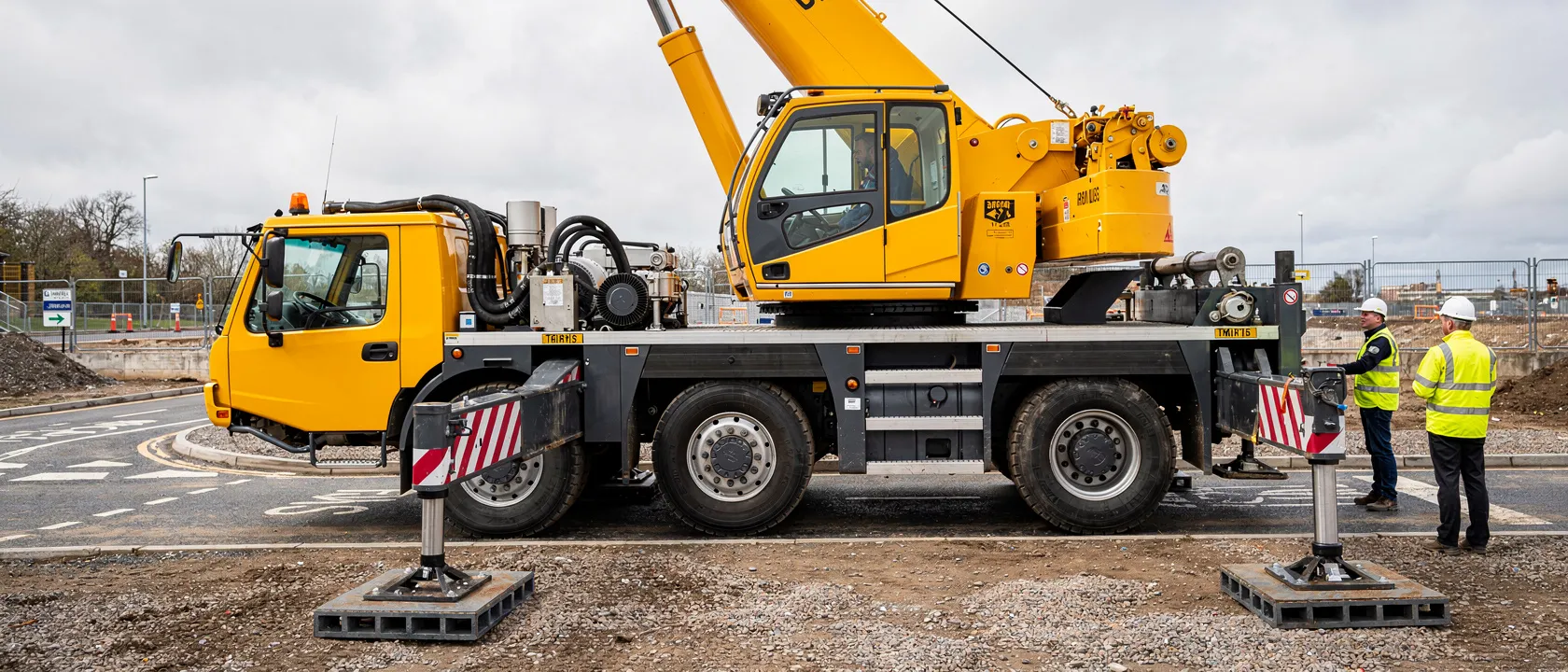
Mobile cranes do more lifting on UK construction sites than any other type. They drive to site, set up in under an hour, lift, and leave the same day. This guide explains how they work, the different types, and how to choose one.
How a mobile crane works
A mobile crane has three main parts:
- The carrier: the wheeled chassis that drives on the road, with a cab for driving.
- The superstructure: the rotating upper part with the operator’s cab, the engine for lifting (on some cranes), the winch and the counterweight.
- The boom: a telescopic boom that extends hydraulically in sections, sometimes with a lattice fly jib for extra reach.
On site, the crane sets up on outriggers: four beams that extend sideways and lower pads to the ground, lifting the wheels clear. The outriggers spread the load and stop the crane tipping. The counterweight balances the load at the other end.
Types of mobile crane
All-terrain cranes
The UK’s most common hire crane. All-wheel drive and all-wheel steering mean they can travel at road speeds and also manoeuvre on rough sites. Sizes run from about 40 tonnes on three axles to over 500 tonnes on nine. Larger cranes travel with separate lorries carrying their counterweight.
City cranes
Short, narrow cranes built for urban sites. Some have a low overall height for working under bridges and inside buildings.
Truck-mounted cranes
A crane on a standard lorry chassis. They are simpler and cheaper to run, and good for lighter lifts on easy sites.
Mobile tower cranes
A tower crane on a mobile chassis that unfolds on site. It gives a long horizontal reach from a small footprint, ideal for lifting over a row of houses.
Typical sizes and what they lift
| Crane | Typical jobs |
|---|---|
| 40 – 60 t | Roof trusses, steel beams, HVAC units, hot tubs at long reach |
| 80 – 130 t | Steel frames, precast stairs and panels, modular buildings |
| 200 – 500 t | Bridge beams, wind components, heavy plant, tower crane erection |
Remember that a crane’s tonnage is its maximum at very short radius. A 60-tonne crane might lift only 5 tonnes at 20 metres. The load chart tells you what it can lift at your radius.
Safety features
Modern mobile cranes have a rated capacity indicator that warns the operator, and stops the crane, if a lift approaches its limit. They also have overhoist protection, outrigger monitoring and wind speed sensors. None of these replaces a proper lift plan and a competent crew.
Who operates a mobile crane?
In the UK, a mobile crane operator usually holds a CPCS A60 card or an NPORS equivalent. Every lift also needs an Appointed Person who plans it, and a slinger-signaller who attaches the load and guides the operator.
Hiring a mobile crane
Most mobile cranes are hired with an operator, either on CPA hire, where you plan the lift, or as a contract lift, where the crane company does. See mobile crane hire for sizes and prices.