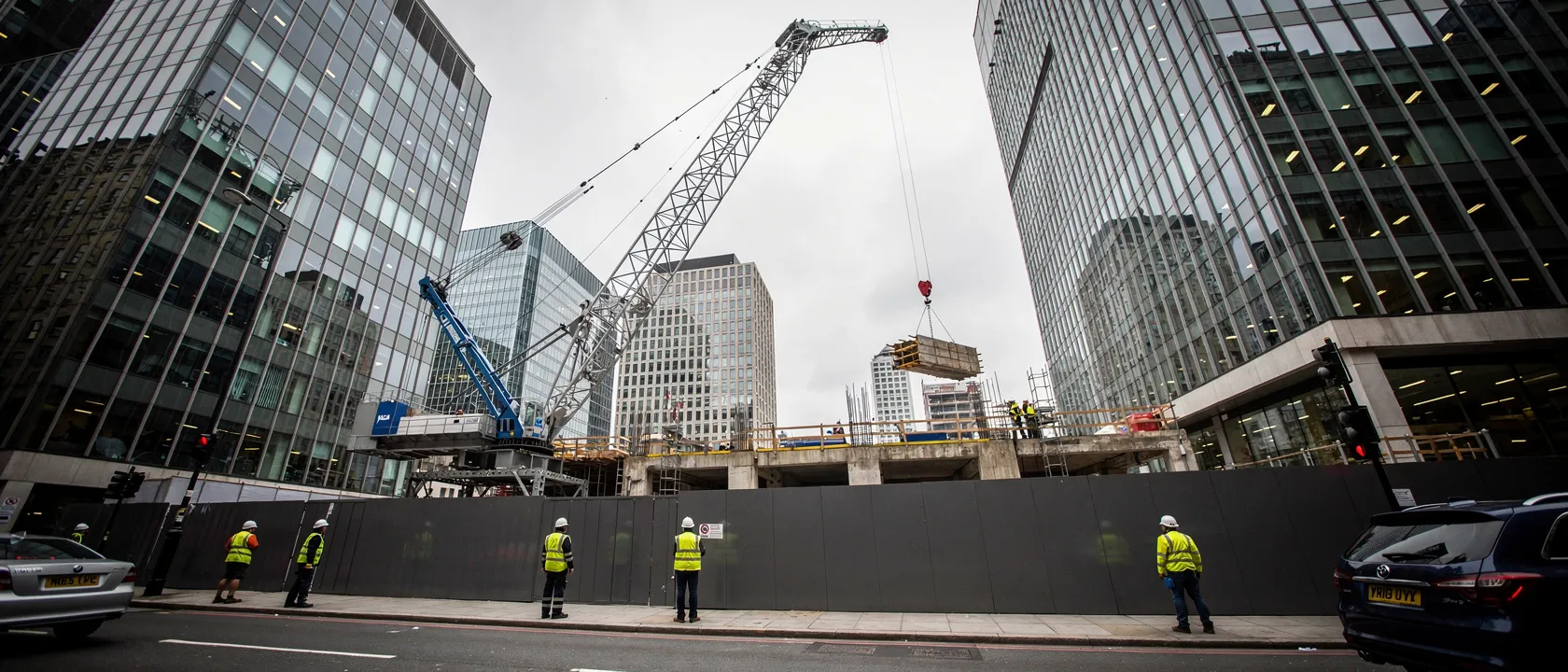
Look at the skyline of London, Manchester or Birmingham and you will see many cranes with their jibs pointing up at an angle. These are luffing jib tower cranes, and they have become the standard choice for building in crowded city centres.
How a luffing jib crane works
On a conventional (hammerhead or flat-top) tower crane, the jib is horizontal and a trolley runs along it to move the load in and out.
On a luffing crane, there is no trolley. Instead, the jib pivots at its base and is raised or lowered by a hoist to change the radius. Raise the jib and the load moves closer to the tower; lower it and the load moves out.
Why cities need them
Smaller swing circle
With the jib raised, a luffing crane takes up a much smaller circle. A hammerhead’s jib and counter-jib always sweep their full length; a luffer can work in a gap between buildings.
Oversail rights
In the UK, swinging a crane jib over a neighbour’s land without permission is trespass into their airspace. Developers negotiate oversail licences, which can take time and cost money. A luffing crane can often keep its jib within the site boundary, or reduce how much it oversails, which makes those negotiations easier.
Several cranes on one site
Large city projects often need two, three or more cranes. Luffing jibs can work close together at different heights with less risk of clashing, and anti-collision systems manage the rest.
Out-of-service position
When not working, tower cranes are left free to turn with the wind (weathervaning). A luffing crane parks with its jib raised, so its out-of-service circle is smaller too.
The trade-offs
- Cost: luffing cranes are more expensive to hire and to erect
- Speed: changing radius by luffing is slower than trolleying, so each lift cycle takes a little longer
- Power: they need more power to raise the jib and load together
- Operator skill: controlling the load path while luffing takes experience
When to choose a luffing crane
A luffing jib makes sense when the site is tight, surrounded by buildings or roads, when oversail rights are limited, or when several cranes must share the airspace. On open sites, a flat-top or hammerhead is usually cheaper.
Planning a luffing crane
Expect to plan the base, ties to the structure, power supply, aerodrome notification (CAA CAP 1096) where relevant, and the lifting plan, often months before the crane arrives. See tower crane hire for what a hire includes.