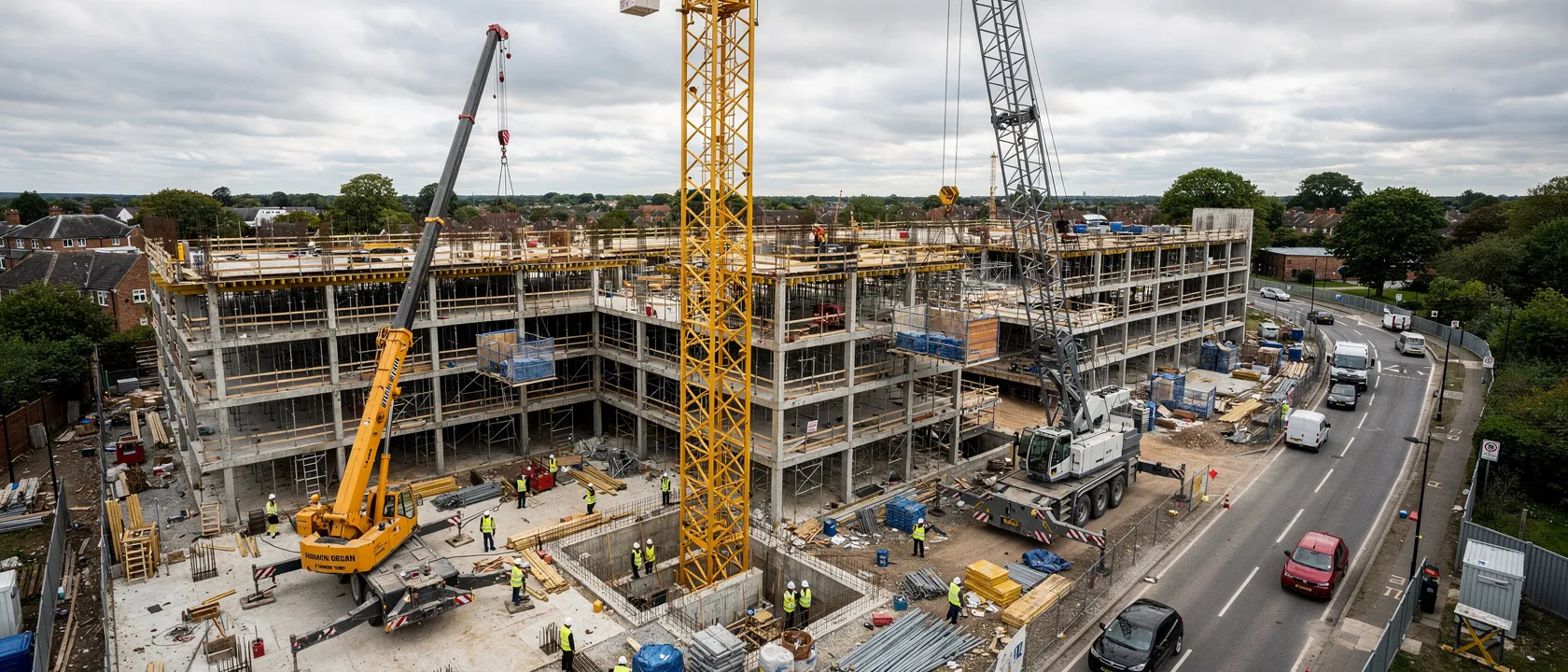
There are dozens of crane designs, but nearly all UK crane hire falls into seven types. This guide covers what each one is, typical sizes, and when to use it.
At a glance
| Type | Typical capacity | Typical max height | Best for |
|---|---|---|---|
| Mobile (all-terrain) | 40 – 500 t | 40 – 100 m | One-day lifts of almost anything |
| City crane | 25 – 60 t | 30 – 45 m | Tight urban streets |
| Lorry crane (HIAB) | c. 8 – 100+ tm | 10 – 25 m | Deliver and place in one visit |
| Spider crane | 0.5 – 10 t | 8 – 30 m | No vehicle access, indoors |
| Tower crane | 2 – 25 t | 30 – 80 m+ | Long projects, high-rise |
| Crawler crane | 30 – 1,000+ t | up to 150 m+ | Soft ground, heavy lifts |
| Rough terrain | 25 – 100 t | 30 – 50 m | Off-road sites |
Capacities are maximums at short radius. What a crane can lift at your radius may be much less.
Mobile cranes
A telescopic crane on a road-going chassis, and the most common hire crane in the UK. All-terrain cranes drive on the road and onto site, set up in under an hour, and come in sizes from 40 tonnes to over 500. Mobile crane hire.
City cranes
A compact mobile crane designed for narrow streets and low headroom. City cranes give up some capacity in exchange for manoeuvrability.
Lorry cranes (HIAB)
A crane mounted on a lorry, rated in tonne-metres. A lorry crane carries the load as well as lifting it, which makes it the most economical choice for deliveries, cabins and lighter lifts. HIAB hire.
Spider and mini cranes
Compact tracked cranes that fit through a doorway and set up on four spider-like legs. Ideal for back gardens, interiors and glazing. What is a spider crane?
Tower cranes
Fixed cranes that stand on a foundation and serve a whole site for months. Types include hammerhead, flat-top, luffing jib and self-erecting. Types of tower crane.
Crawler cranes
Cranes on steel tracks that spread their weight over soft ground and can travel with the load. They are used for heavy and long-term lifting, from piling to bridges and wind turbines. Crawler crane hire.
Rough terrain cranes
Two-axle cranes with large tyres for off-road sites. They are common in some countries but rare in UK hire fleets, where all-terrain cranes do the same job and can also drive on the road. More on rough terrain cranes.
Other cranes you may meet
- Overhead (gantry) cranes run on rails inside factories and warehouses. They are part of the building, not usually hired.
- Floating cranes work from barges on rivers and ports.
- Pedestal cranes are fixed to offshore platforms, ships and quaysides.
Which crane do you need?
Start with the load weight, the radius, the access and the ground. Our guide to choosing the right crane walks you through it, or send us the details and we will size it for you.