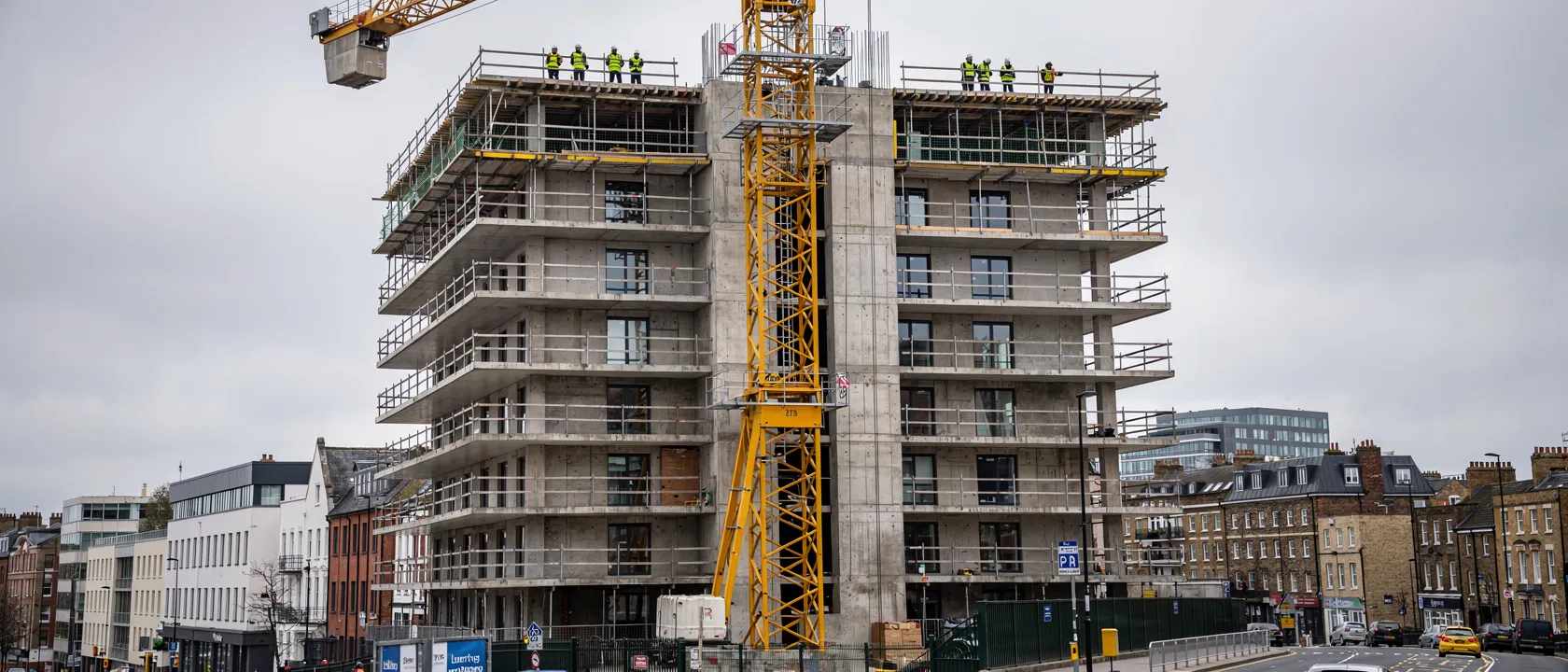
Every tall building in the UK goes up with the help of at least one tower crane. It lifts the steel, concrete, formwork and façade panels that make up the structure, and it often stays on site from the first slab to topping out. Here is how tower cranes work on high-rise jobs, and the safety controls that go with them.
What the crane does on a high-rise site
- Heavy lifts: steel columns and beams, precast cores, rebar and formwork
- Concrete: skips of concrete to the pour, where a pump cannot reach
- Façade: cladding panels and curtain wall units placed precisely
- Logistics: moving materials from the delivery bay to every floor
Getting the crane up
The base
A tower crane stands on a foundation designed by a temporary works engineer: a mass concrete base, a piled base, or a frame fixed to the building’s own structure. The design accounts for the crane’s weight, the load moments, and wind on the tower and jib.
Climbing
On tall buildings the crane must grow with the structure. It does this by climbing: a hydraulic climbing frame lifts the top of the crane so new tower sections can be inserted. Some cranes climb inside the building’s core instead, rising floor by floor.
Ties
Above a certain height, the tower is tied to the building at intervals to keep it stable. The ties and the loads they put on the structure are part of the temporary works design.
Safety on a high-rise crane
Planning and people
Every lift falls under LOLER and BS 7121-5 (tower cranes). A tower crane site has an Appointed Person, a crane supervisor, carded operators and slinger-signallers. Lifts are planned, not improvised.
Wind
Wind is the biggest day-to-day limit at height. Each crane has an anemometer and a maximum in-service wind speed set by the manufacturer, commonly around 20 m/s for the crane itself, and often lower for loads with a large surface area such as façade panels. When the limit is reached, lifting stops and the crane is left free to weathervane.
Exclusion zones and lifting over people
Loads should not pass over people. Sites plan lifting routes, use exclusion zones below the work and keep the public away with hoardings and timing.
Anti-collision and zoning
Where cranes overlap, or the jib could swing over a road or railway, electronic zoning and anti-collision systems stop the crane entering restricted areas.
Inspection
Tower cranes are thoroughly examined after erection and after each climb, at least every 12 months, and after any event that could affect safety, with weekly checks in between.
Working at height on site
High-rise sites combine crane work with other high-risk activity: edge protection, working platforms and safe access for the crane operator, who may climb many metres to the cab. All of it sits within the site’s Construction (Design and Management) Regulations 2015 duties.
Planning a tower crane
If your project is approaching the point where a tower crane makes sense, start early. Foundations, oversail agreements and aerodrome notifications all take time. See tower crane hire, or talk to us about your project.