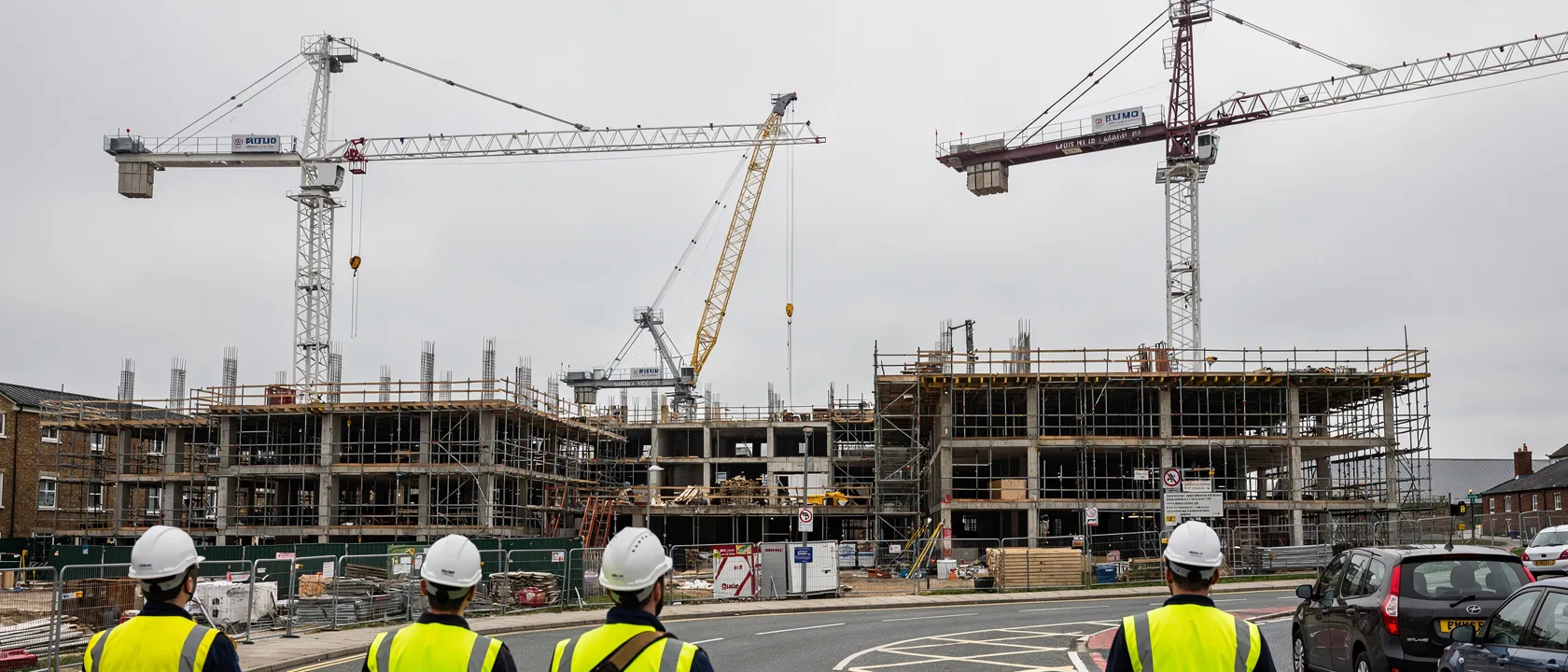
All tower cranes do the same basic job, lifting materials around a site from a fixed tower, but the five main types work in quite different ways. Choosing the right one depends on site size, neighbours and how long you need it.
Quick comparison
| Type | Jib | Typical capacity | Best for |
|---|---|---|---|
| Hammerhead | Horizontal, with a tower top | 4 – 20 t | Open sites, long jibs |
| Flat-top (topless) | Horizontal, no tower top | 4 – 25 t | Multiple cranes, height limits |
| Luffing jib | Raises and lowers | 6 – 25 t | Tight city sites |
| Self-erecting | Folding | 1 – 8 t | Housing, short projects |
| Mobile tower crane | Folding, on a truck | 4 – 10 t | One-day lifts over buildings |
Hammerhead tower cranes
The classic tower crane shape: a horizontal jib with a counter-jib behind, held up by ties to an apex (tower top) above the cab. A trolley runs along the jib to move the load in and out. Hammerheads offer long jibs and good capacity, and are economical on open sites where the jib can swing freely.
Flat-top (topless) tower cranes
Similar to a hammerhead, but without the apex and ties. The jib sections are self-supporting. That brings two big advantages:
- Several cranes can overlap at different heights without their tops clashing
- They are quicker to erect and dismantle, as the jib needs fewer lifts to assemble
Flat-tops are now the most common type on many UK sites.
Luffing jib tower cranes
Instead of a trolley, a luffing crane raises and lowers its jib to change radius, like an arm. When raised, the jib takes up a much smaller circle. That means:
- it can work in tight city sites without swinging over neighbouring buildings
- oversail agreements with neighbours are easier, or not needed
- several luffing cranes can work close together
The trade-off is cost and speed: luffing cranes are more expensive and each lift cycle takes a little longer. Read more about luffing jib cranes in cities.
Self-erecting tower cranes
Smaller cranes that fold up for transport and erect themselves on site, usually in a few hours, using their own motors. They sit on a ballasted base rather than a deep foundation. Self-erectors are ideal for housing developments, schools and small commercial projects, and are often operated by remote control from the ground.
Mobile tower cranes
A tower crane mounted on a mobile crane chassis. It drives to site, unfolds in about an hour and gives a long horizontal reach over buildings. Perfect for one-day lifts such as roofing, lifting materials into gardens behind terraces, or placing garden rooms and hot tubs.
Which one do you need?
- Long project, open site: hammerhead or flat-top
- Several cranes on one site: flat-top
- City centre with neighbours on every side: luffing jib
- Housing or a small project for a few months: self-erecting
- A day or two of lifting over buildings: mobile tower crane
See tower crane hire for what a hire includes, or ask for a proposal.