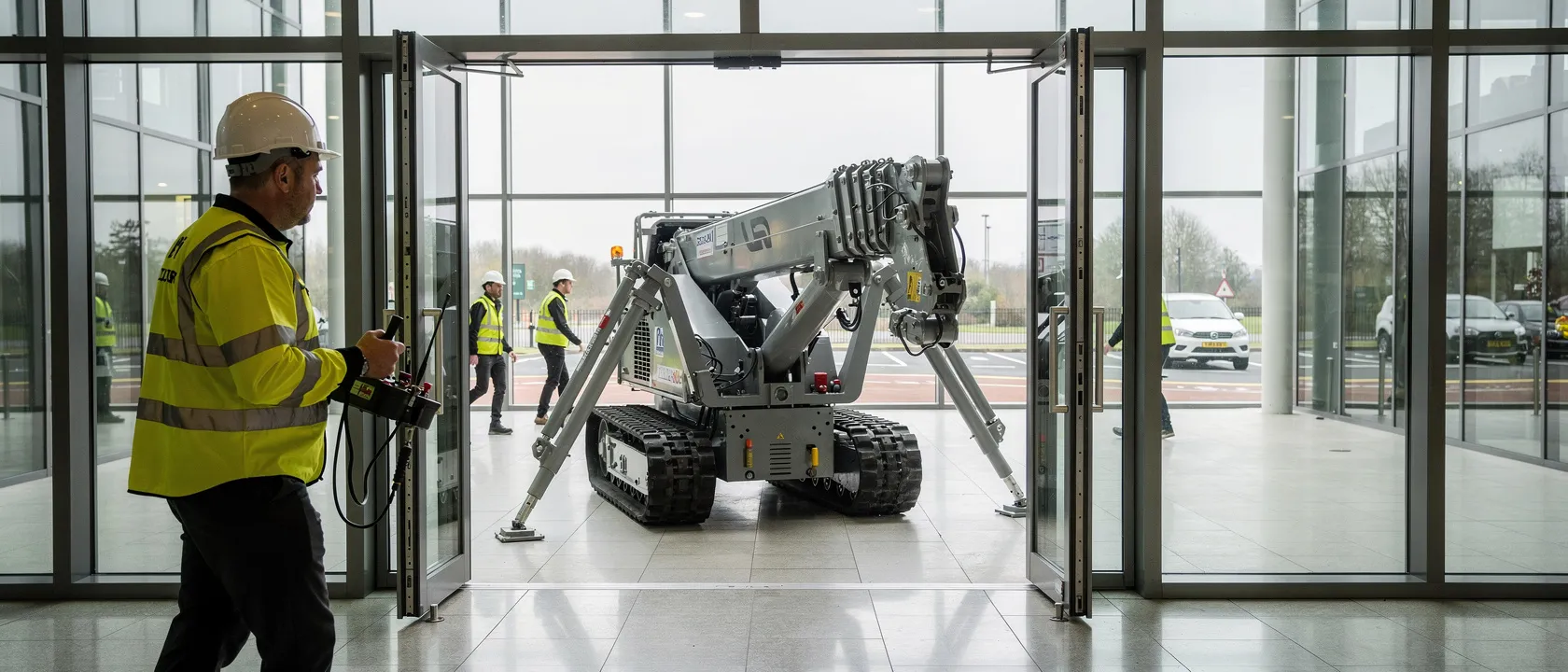
A spider crane is a compact tracked crane that can fit through a doorway, then unfold four outrigger legs and lift loads of up to about 10 tonnes. It gets its name from those legs, which splay out like a spider’s.
How a spider crane works
- Travel. The crane drives on rubber tracks, controlled by the operator walking alongside with a remote. In travel mode the smallest models are only about 600 mm wide.
- Set-up. At the lift position, the four outriggers fold out and down onto spreader mats. The crane levels itself and lifts its tracks off the ground.
- Lifting. A telescopic boom extends and the winch raises the load. Many spider cranes are operated by radio remote, so the operator can stand where they have the best view of the load.
- Attachments. A fly jib adds reach, a vacuum lifter handles glass and stone, and a man-basket allows certain work at height.
Most spider cranes run on diesel, but many also have an electric motor for indoor work with no exhaust fumes.
Sizes and capacities
| Class | Capacity | Width | Hook height |
|---|---|---|---|
| Compact | up to 1 t | 600 – 750 mm | 8 – 9 m |
| Mid-size | 2.5 – 4 t | 750 – 1,300 mm | 13 – 17 m |
| Large | 5 – 10 t | 1.3 – 2 m | 20 – 30 m |
As with all cranes, the maximum capacity applies only at the shortest radius. At full reach a 3-tonne spider crane might lift only a few hundred kilograms.
What spider cranes are used for
- Glazing: placing large glass panels, rooflights and curtain walling with a vacuum lifter
- Steelwork: lifting beams into rear extensions and loft conversions
- Indoor installation: plant, machinery and glass inside shopping centres, atriums and factories
- Restricted sites: courtyards, back gardens, basements and rooftops (lifted up by a larger crane)
Advantages
- Access: gets where no other crane can, through a house or a side passage
- Small footprint: sets up in a space a little larger than a car parking bay
- Light: often avoids the need for a highway permit, because the crane works inside the site
- Precise: fine controls suit delicate loads like glass
What to check before hiring
- The access route: the narrowest point, steps, slopes and tight turns
- The ground or floor: outrigger loads can be high, so check cellars, drains and suspended floors
- The load and radius: the weight including attachments, and how far it needs to go from the crane
- Overhead: cables, ceilings and trees
Hiring a spider crane
Spider cranes are hired with a trained operator, usually by the half day or day. See spider crane hire for sizes and prices, or send us your job for a fixed quote.