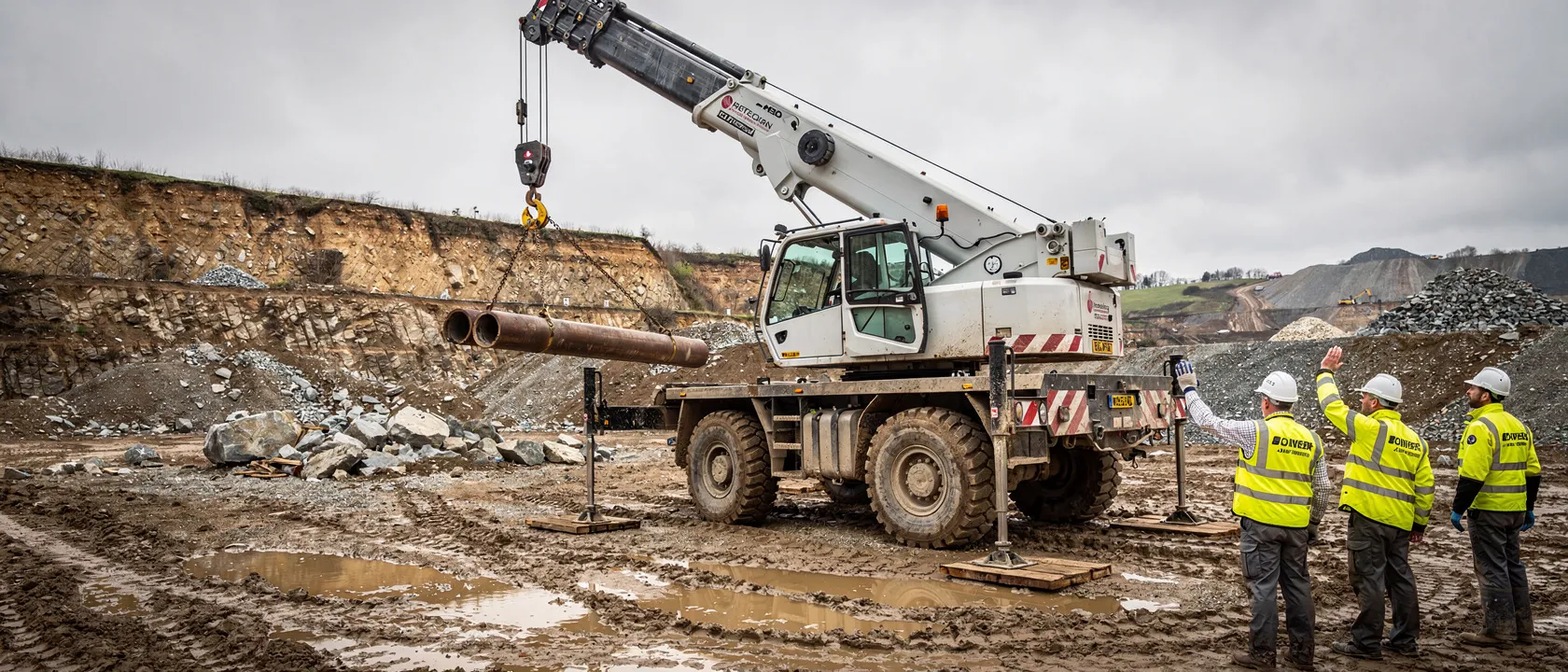
Rough terrain cranes are built for one thing: working on unmade, uneven ground. They are a familiar sight on construction and industrial sites in North America and the Middle East, but much less common in the UK. Here is what makes them different, and what UK projects normally use instead.
What is a rough terrain crane?
A rough terrain (RT) crane is a telescopic boom crane on a two-axle chassis with large off-road tyres, four-wheel drive and four-wheel steering. Unlike an all-terrain crane, it usually has one cab that is used both for driving and for operating the crane.
Typical features:
- capacities from about 25 to 100 tonnes
- a short wheelbase and tight turning circle
- high ground clearance for rough sites
- outriggers for full-capacity lifts, with limited pick-and-carry ability on tyres
How they differ from other cranes
| Rough terrain | All-terrain | Crawler | |
|---|---|---|---|
| Drives on public roads | Usually not; transported on a low-loader | Yes | No |
| Off-road ability | Excellent | Good | Excellent |
| Capacity range | 25 – 100 t | 40 – 500+ t | 30 – 1,000+ t |
| Travels with a load | Limited, on tyres | No | Yes |
| Set-up time | Fast | Fast | Slow for lattice types |
Variants
- Compact RT cranes are smaller machines for refineries, plants and tight industrial sites.
- Heavy RT cranes have higher capacities and longer booms for bigger site work.
- Industrial cranes are a related type of pick-and-carry crane with a fixed cab, used inside plants and yards.
Why they are rare in UK hire fleets
Most UK lifts are short-term jobs where the crane drives to site, lifts, and leaves the same day. An RT crane has to be carried on a low-loader, which adds cost to every job. All-terrain cranes do the same work on most sites and can drive on the road, so UK hire companies invest in those instead.
For long projects on genuinely rough or soft ground, a crawler crane usually beats an RT crane on capacity and stability.
When an RT crane still makes sense
- long-term work on large, unmade sites such as quarries, energy projects and industrial plants
- sites where a crane must move frequently between lift positions off-road
- projects where a contractor already owns or has one on long-term hire
Choosing the right alternative
If your site has difficult ground, tell us about it when you ask for a quote: photos, any ground investigation, and where the crane would need to stand. We will recommend an all-terrain or crawler crane and any mats or platform needed.